Updated: October 21, 2026
A guide for salons and clinics: microneedling pen or RF microneedling, number of sessions, contraindications and the criteria for choosing a professional machine.
In short
- Microneedling creates controlled micro-channels in the skin, and the healing response builds new collagen and elastin.
- A microneedling pen works mechanically. RF microneedling adds heat in the dermis, at the set depth, for scars and laxity.
- Typical protocols have 3 to 6 sessions, 4 to 6 weeks apart.
- Results are assessed at about 3 months, the time collagen remodelling takes.
- On the machine, what counts is adjustable depth, insulated needles, sterile cartridges and protocol training.
What is microneedling
Microneedling, also called collagen induction therapy, is a treatment in which very fine needles enter the skin to a controlled depth. Each puncture creates a micro-channel and the skin starts a healing process: growth factors are released and fibroblasts produce new collagen and elastin. The surface heals within days, while remodelling in the dermis continues for months.
Professional treatment uses an electric microneedling pen or an RF microneedling machine, which also delivers thermal energy through the needles. Home dermarollers work at shallow depths, around 0.25 mm, so they only reach the surface layer of the skin.
Depth decides the effect. As a guide, texture and pores are treated at 0.5 to 1 mm, while acne scars and stretch marks need 1.5 mm and more, set by the practitioner for the area and skin thickness.
Microneedling pen or RF microneedling
Both technologies use needles and start the same healing response. The difference is the energy delivered: the pen works mechanically, while the RF machine heats the dermis through the needles and adds a tissue tightening effect.
| Microneedling pen | RF microneedling | |
|---|---|---|
| How it works | Mechanical micro-punctures | Micro-punctures plus RF energy released in the dermis |
| Typical depth | Up to 2.5 or 3 mm, by model | 0.5 to 3.5 mm on MiFocus RF |
| Main indications | Texture, pores, fine lines, shallow scars | Acne scars, mild laxity, wrinkles, stretch marks |
| Typical sessions | 3 to 6 | 3 to 4 |
| Redness afterwards | 1 to 3 days | A few hours to a few days, by energy |
| Consumable per session | Sterile needle cartridge | Sterile cartridge with insulated needles |
On RF machines, insulated needles have a bare tip and a coated shaft. The energy is released only in the dermis, at the set depth, and the epidermis stays protected. For MiFocus RF, the manufacturer reports a post-treatment hyperpigmentation risk below 0.3%.
What microneedling treats
- Acne scars, especially boxcar and rolling scars.
- Enlarged pores and uneven skin texture.
- Fine lines and early laxity on the face and neck.
- Stretch marks on the abdomen, thighs and arms.
- Old surgical scars, with a doctor's approval.
- The scalp, in hair loss protocols, usually combined with other treatments.
Microneedling is often combined with serums applied straight after the session, while the micro-channels are open. The products used must be sterile and made for this kind of application.
How many sessions and how much downtime
Typical protocols have 3 to 6 sessions, 4 to 6 weeks apart. The interval gives the skin time to build collagen between sessions. Results on scars and wrinkles are assessed about 3 months after the last session.
What happens after a session
- First hours: redness similar to mild sunburn and a feeling of warmth.
- Days 1 to 3: dry, slightly sensitive skin. Make-up usually goes back on after 24 hours, as the practitioner advises.
- First week: strict sun protection, no exfoliants and no retinoids.
With RF at low energy, redness usually lasts less. For MiFocus RF, the manufacturer indicates mild redness that settles within 6 to 12 hours.
Do you run a salon, clinic or rehabilitation centre?
Tell us which treatments you want to offer and how many clients you see a day. We come back with the right model, the full price and what the delivery includes.
Contraindications and precautions
The practitioner reviews the client's record before each course. Treatment is postponed or avoided in the cases below.
- Active acne, infection or active cold sores in the treated area.
- A tendency to keloid scarring.
- Isotretinoin in the last 6 months.
- Pregnancy and breastfeeding.
- Bleeding disorders or anticoagulant treatment, with a doctor's approval.
- For RF microneedling: pacemakers, other implanted electronic devices and metal implants in the treated area.
Microneedling breaks the skin. Sterile single-use cartridges, skin disinfection and room hygiene are basic conditions of every session.
How to choose a professional microneedling machine
For a salon or clinic, the machine decides which indications you can treat and what each session costs. The criteria below separate a professional microneedling machine from a home device.
- Depth adjustable in small steps, with a range that also covers scars, for example 0.5 to 3.5 mm.
- Insulated needles on RF machines, so the energy works only in the dermis.
- Several cartridge types, for small areas (eyes, lips) and large areas (abdomen, thighs).
- Sterile single-use cartridges, with price and availability known in advance.
- A stable motor and controlled needle firing, for even treatment across the area.
- CE marking, declaration of conformity and user manual.
- Protocol training and service after installation.
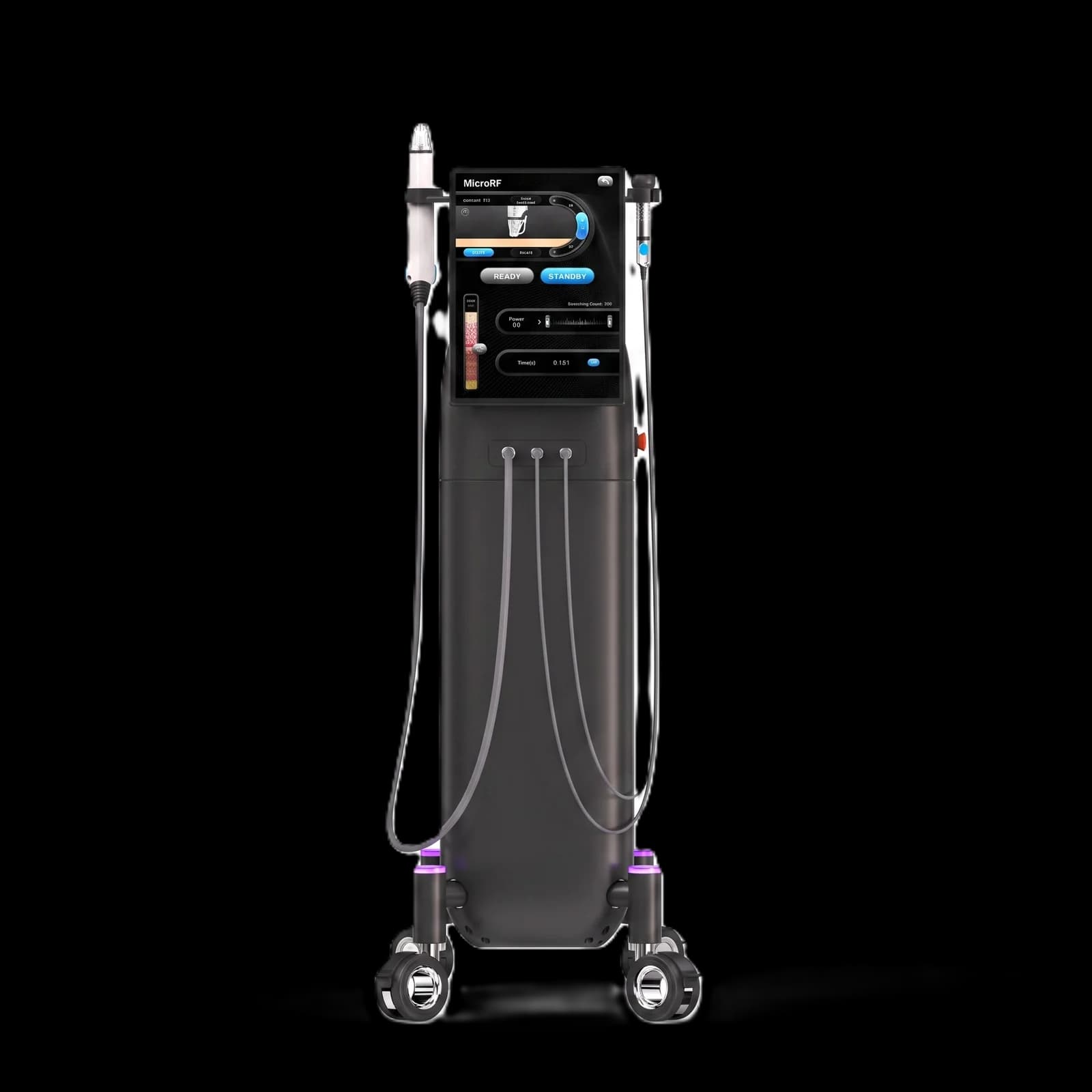
Fractional radiofrequency microneedling machine: insulated needles of 0.15 mm, depth adjustable between 0.5 and 3.5 mm and five cartridges, from 9 to 49 needles. Three working modes and random needle firing for reduced trauma.
MiFocus RF has 0.15 mm insulated needles, depth adjustable from 0.5 to 3.5 mm, five cartridges from 9 to 49 needles and three working modes. The configuration covers the face, the eye area, the neck and the body.
Microneedling on your treatment menu
Microneedling is usually sold as a course, because the protocol has several sessions. Three figures drive the business case: the cartridge cost per session, the session length and the number of sessions you can book in a week.
A facial session takes about an hour including preparation: numbing cream stays on for 30 to 45 minutes and the treatment itself takes 20 to 30 minutes.
An RF machine covers more indications than a pen, so it also serves clients with scars or laxity. In the same room it pairs with HIFU for lifting and with laser hair removal for a clinic working on face and body.
The Zeqira quote lists the machine, delivery, installation, protocol training and the consumable cost per session, in writing before you order.
Do you run a salon, clinic or rehabilitation centre?
Tell us which treatments you want to offer and how many clients you see a day. We come back with the right model, the full price and what the delivery includes.
Frequently asked questions
What is microneedling?
Microneedling is a treatment in which fine needles create controlled micro-channels in the skin. The skin responds with a healing process that produces new collagen and elastin, improving texture, pores, scars and fine lines.
What is the difference between a microneedling pen and RF microneedling?
A pen makes mechanical micro-punctures only. An RF microneedling machine also sends thermal energy through the needles into the dermis, at the set depth, and treats acne scars and mild laxity more effectively.
How many microneedling sessions are needed?
Typical protocols have 3 to 6 sessions, 4 to 6 weeks apart. With RF, a course usually has 3 to 4 sessions.
Does microneedling hurt?
Discomfort is controlled with numbing cream applied 30 to 45 minutes before. The feeling during the session is usually described as vibration with light pricking.
When are the results visible?
Skin looks more even after 1 to 2 weeks. The effect on scars and wrinkles is assessed about 3 months after the last session, the time collagen takes to form.
Can you have microneedling in summer?
Yes, with strict sun protection in the weeks after the session. Courses for scars are usually booked in autumn and winter, when sun exposure is lower.
How much does an RF microneedling machine cost?
The price depends on the number of cartridges, the working modes and the maximum depth. We send the full price for the configuration you choose, with delivery, installation, training and the cartridge cost per session.
Get a quote for the right machine
The quote covers the machine, delivery, installation, protocol training and the consumable cost per session. We work with companies, salons, clinics and hospitals.