Updated: October 21, 2026
A guide for physiotherapy clinics and aesthetic salons: how TECAR radiofrequency works, the difference between capacitive and resistive modes, indications, number of sessions, contraindications and the criteria for choosing a machine.
In short
- TECAR is radiofrequency diathermy: the current passes through tissue and produces heat inside it, called endogenous heat.
- Capacitive mode works on muscle, the lymphatic system and fat tissue. Resistive mode reaches tendons, ligaments, joints and fascia.
- It is used in rehabilitation, for muscle injuries, tendinopathies and chronic pain, and in aesthetics, for body contouring and firmness.
- A session takes 15 to 30 minutes and a typical course has 5 to 10 sessions.
- Pacemakers, pregnancy, tumours and venous thrombosis are contraindications.
What is TECAR therapy
TECAR stands for Transfer of Energy Capacitive and Resistive. It is a form of radiofrequency diathermy: an alternating current in the hundreds of kilohertz, often 448 kHz, passes through tissue between an active electrode and a return plate. The tissue resists the current and the energy turns into heat produced inside it, called endogenous heat.
The heat increases local circulation, cell metabolism and lymphatic drainage. Therapists work at three intensity levels: athermic, with no perceptible heating, for the acute phase of an injury; mildly thermal, for the subacute phase; thermal, with noticeable heat, for chronic conditions.
Capacitive and resistive mode
| Capacitive (CAP) | Resistive (RES) | |
|---|---|---|
| Electrode | Insulated | Metal, uninsulated |
| Where the energy concentrates | Under the electrode, in water-rich tissue | In higher-resistance tissue, along the path to the return plate |
| Tissue treated | Muscle, lymphatic system, superficial fat | Tendons, ligaments, joints, fascia, bone |
| Depth on Legenda | 3 to 5 cm | 6 to 8 cm |
In one session the therapist usually uses both modes: capacitive for the surrounding muscles and resistive for the affected structure, such as the tendon or joint.
What TECAR therapy is used for
In rehabilitation and physiotherapy
- Muscle injuries and contractures.
- Tendinopathies: Achilles tendon, tennis elbow, shoulder.
- Sprains and ligament injuries, after the acute phase.
- Low back and neck pain.
- Rehabilitation after orthopaedic surgery, with the doctor's approval.
- Oedema and lymphatic drainage.
In aesthetics
- Body contouring and cellulite, through drainage and stimulation of fat tissue metabolism.
- Skin firmness on the face and body.
- Preparing tissue before other contouring treatments.
TECAR is often combined with manual therapy and exercise: the heat prepares the tissue and the physiotherapist works in the same session.
Session length and number of sessions
A session usually takes 15 to 30 minutes per area. A typical course has 5 to 10 sessions, 2 to 3 times a week. The exact number is set by the physiotherapist or doctor after assessment.
The client feels deep warmth. Professional machines monitor tissue temperature throughout the session, and intensity is adjusted to the patient's feedback.
Do you run a salon, clinic or rehabilitation centre?
Tell us which treatments you want to offer and how many clients you see a day. We come back with the right model, the full price and what the delivery includes.
TECAR therapy contraindications
- Pacemakers and other implanted electronic devices.
- Pregnancy.
- Tumours in the treated area, without the oncologist's approval.
- Venous thrombosis or thrombophlebitis.
- Impaired thermal sensation in the area.
- Acute infection and fever.
- Metal implants in the treated area, especially in resistive mode, after assessment.
The therapist reviews the patient record before the course and matches intensity to the injury phase: athermic in the acute phase, thermal in the chronic phase.
TECAR, shockwave or therapeutic laser
| TECAR | Shockwave | Therapeutic laser | |
|---|---|---|---|
| Energy | Radiofrequency, endogenous heat | Mechanical acoustic pulses | Light, photobiological effect |
| Sensation | Warmth | Strong pulses, sometimes painful | Mild warmth |
| Typical indications | Muscle, tendons, oedema, chronic pain | Calcific tendinopathy, plantar fasciitis | Pain, superficial inflammation |
| Session length | 15 to 30 minutes | 5 to 10 minutes | 5 to 15 minutes |
Rehabilitation clinics use TECAR alongside physiotherapy tables and the equipment on the medical rehabilitation page.
What to look for in a TECAR therapy machine
- Working frequency, usually 448 kHz.
- Both modes, capacitive and resistive, with separate electrodes.
- Several electrode sizes, for small joints and large areas.
- Real-time temperature control and display.
- Enough power for resistive mode on deep structures.
- Consumables: conductive cream and return plate.
- CE marking, declaration of conformity, service and protocol training.
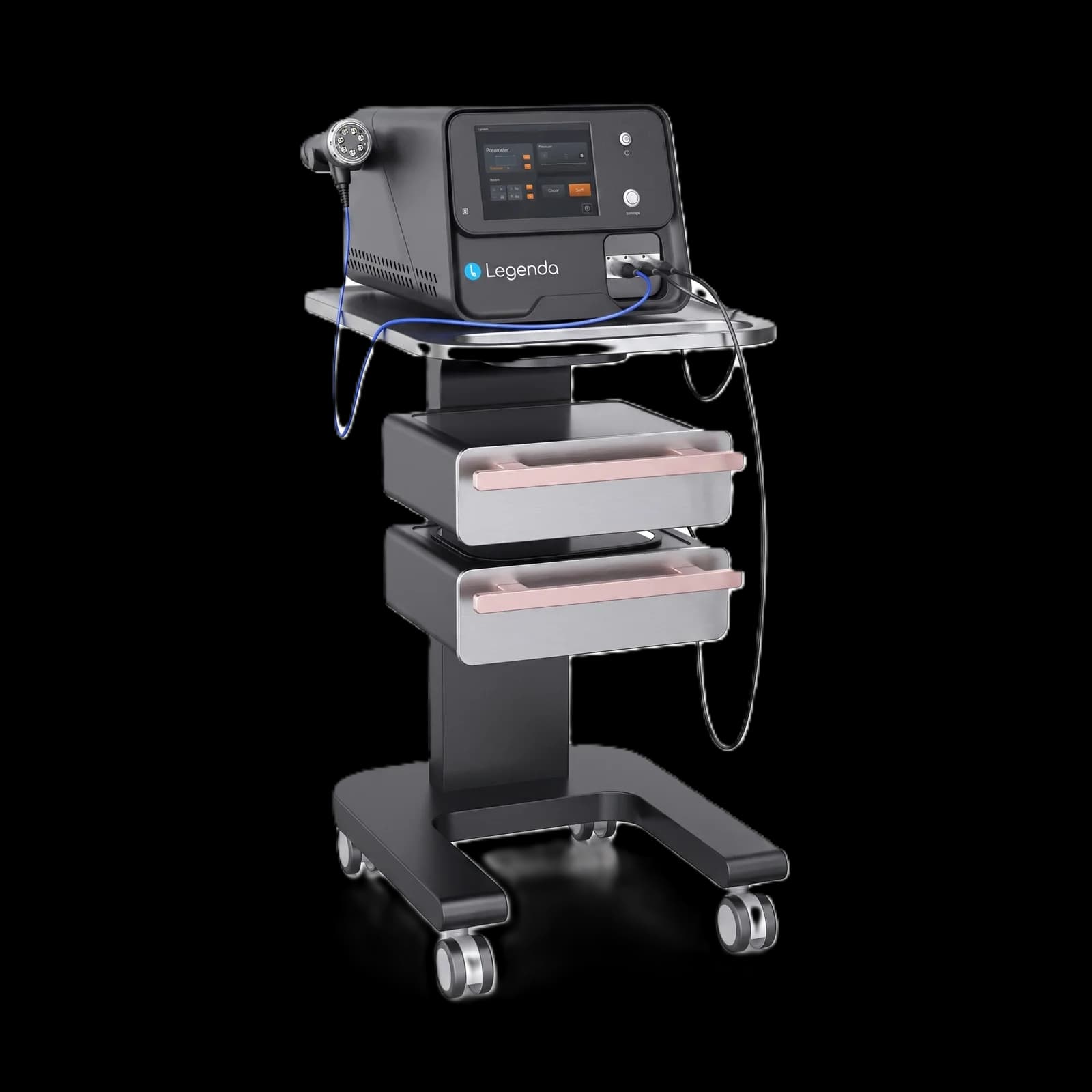
Radiofrequency system of 448 kHz with capacitive and resistive modes, penetration of 3 to 5 cm in capacitive mode and 6 to 8 cm in resistive mode. Seven treatment tips between 40 and 90 mm and real time temperature monitoring.
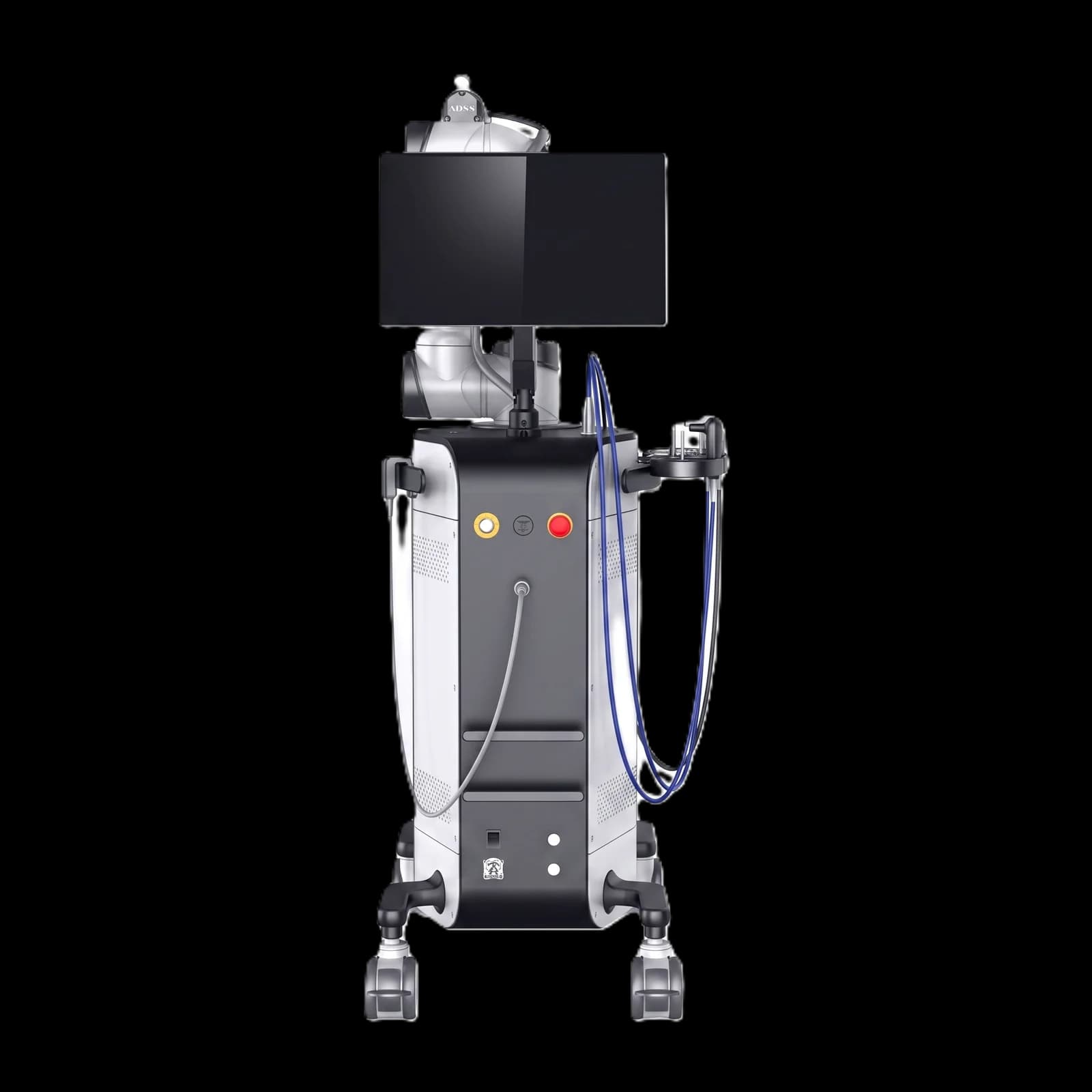
A 448 kHz radiofrequency system applied through an AI-guided robotic arm: infrared recognition with depth cameras, 6-axis force feedback and 360° coverage. Seven treatment modes and automated operation, with no dedicated therapist.
Legenda works at 448 kHz, with 3 to 5 cm capacitive and 6 to 8 cm resistive depth, seven tips from 40 to 90 mm and real-time temperature control. AI Master applies 448 kHz radiofrequency through a robotic arm guided by depth cameras, for centres with many sessions a day.
TECAR in a rehabilitation clinic and in a salon
TECAR is sold per session or as a course. The business case rests on session length, consumables and the fact that the same machine works in both rehabilitation and aesthetics.
In a salon, TECAR complements fat freezing in body contouring programmes. In rehabilitation centres it works next to the hyperbaric chamber and physiotherapy equipment.
The Zeqira quote lists the machine, delivery, installation, protocol training and the consumable cost per session.
Do you run a salon, clinic or rehabilitation centre?
Tell us which treatments you want to offer and how many clients you see a day. We come back with the right model, the full price and what the delivery includes.
Frequently asked questions
What does TECAR therapy do?
TECAR therapy passes radiofrequency current, usually at 448 kHz, through tissue and produces heat inside it. The heat increases circulation, cell metabolism and lymphatic drainage, which supports muscle and tendon recovery and body contouring.
What is TECAR therapy used for?
In rehabilitation: muscle injuries and contractures, tendinopathies, sprains after the acute phase, low back and neck pain, post-operative recovery and oedema. In aesthetics: body contouring, cellulite and skin firmness.
How long is a TECAR session?
Usually 15 to 30 minutes per area.
How many TECAR sessions are needed?
A typical course has 5 to 10 sessions, 2 to 3 times a week. The exact number is set by the therapist after assessment.
What are the contraindications for TECAR therapy?
Pacemakers and other electronic implants, pregnancy, tumours in the treated area, venous thrombosis, impaired sensation, acute infection with fever and metal implants in the treated area, after assessment.
What is the difference between TECAR and shockwave therapy?
TECAR uses radiofrequency and produces heat in the tissue, with 15 to 30 minute sessions. Shockwave therapy uses mechanical acoustic pulses, mainly for calcific tendinopathy and plantar fasciitis, with short sessions.
How much does a TECAR therapy machine cost?
The price depends on power, working modes, number of electrodes and the temperature control system. We send the full price with delivery, installation, training and consumables.
Get a quote for the right machine
The quote covers the machine, delivery, installation, protocol training and the consumable cost per session. We work with companies, salons, clinics and hospitals.